
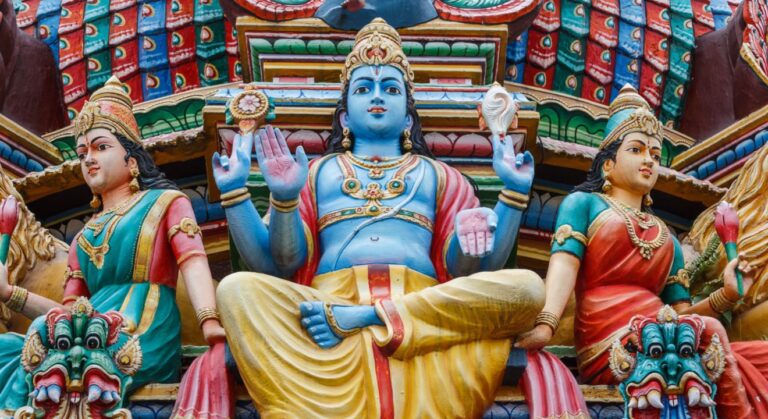
Hinduism
The History of Hinduism
Hinduism, also known as Sanātana Dharma — “the Eternal Way” — is one of the world’s oldest living religious traditions, with roots extending back thousands of years in the Indian subcontinent.
Unlike many religions, Hinduism does not trace its beginnings to a single founder or one historical moment. Instead, it developed over centuries through sacred teachings, spiritual practices, philosophical traditions, and the experiences of countless sages and seekers.
The Vedas — the oldest sacred writings, containing hymns, rituals, and spiritual knowledge.
The Upanishads — philosophical teachings on the soul and ultimate truth.
The Bhagavad-Gītā — Lord Krishna’s guidance on duty, devotion, and spiritual wisdom.
The Ramayana & Mahabharata — epic stories that teach values, devotion, and dharma.
The Puranas — sacred stories of divine incarnations, traditions, and cosmic creation.
A Way of Life
Hinduism is both a spiritual path and a way of life, encouraging worship, inner reflection, family traditions, festivals, and service to others.
Its teachings invite each person to live with purpose, compassion, humility, and devotion.
Basic Beliefs of Hinduism
Dharma (Righteous Living)
Living with truth, compassion, duty, and integrity.
Karma (Cause and Effect)
Every action has a consequence. Good actions bring positive outcomes.
Reincarnation (Cycle of Birth and Rebirth)
The soul evolves across lifetimes, learning and growing spiritually.
Atman (The Divine Soul)
The soul within each person is eternal, pure, and connected to the Divine.
Brahman (One Supreme Divine Reality)
The Divine is one universal reality, expressed and worshiped in many forms.
Moksha (Liberation)
The ultimate spiritual goal—freedom from the cycle of rebirth and union with the Divine.
Reverence for All Life
Hindu teachings emphasize compassion, nonviolence, and respect for all living beings.
This principle, known as ahimsa, reflects the belief that the Divine is present throughout creation.
Spiritual Practices
Hindu spiritual practices offer many paths for developing a deeper connection with the Divine. These may include:
Prayer & Worship (Puja) — offering prayers, flowers, food, and devotion to the Divine.
Meditation — quieting the mind and cultivating inner peace and spiritual awareness.
Yoga — a spiritual discipline that brings the body, mind, and spirit into greater harmony.
Chanting & Mantras — sacred sounds and prayers used to focus the mind and express devotion.
Seva (Selfless Service) — serving others without expectation of personal reward.
“When we hear of the Self, we must reflect on the Self.
When we reflect on the Self, we must meditate on the Self.
Through meditation and divine grace, the Self is realized.”
— Brihadaranyaka Upanishad 4.5.6